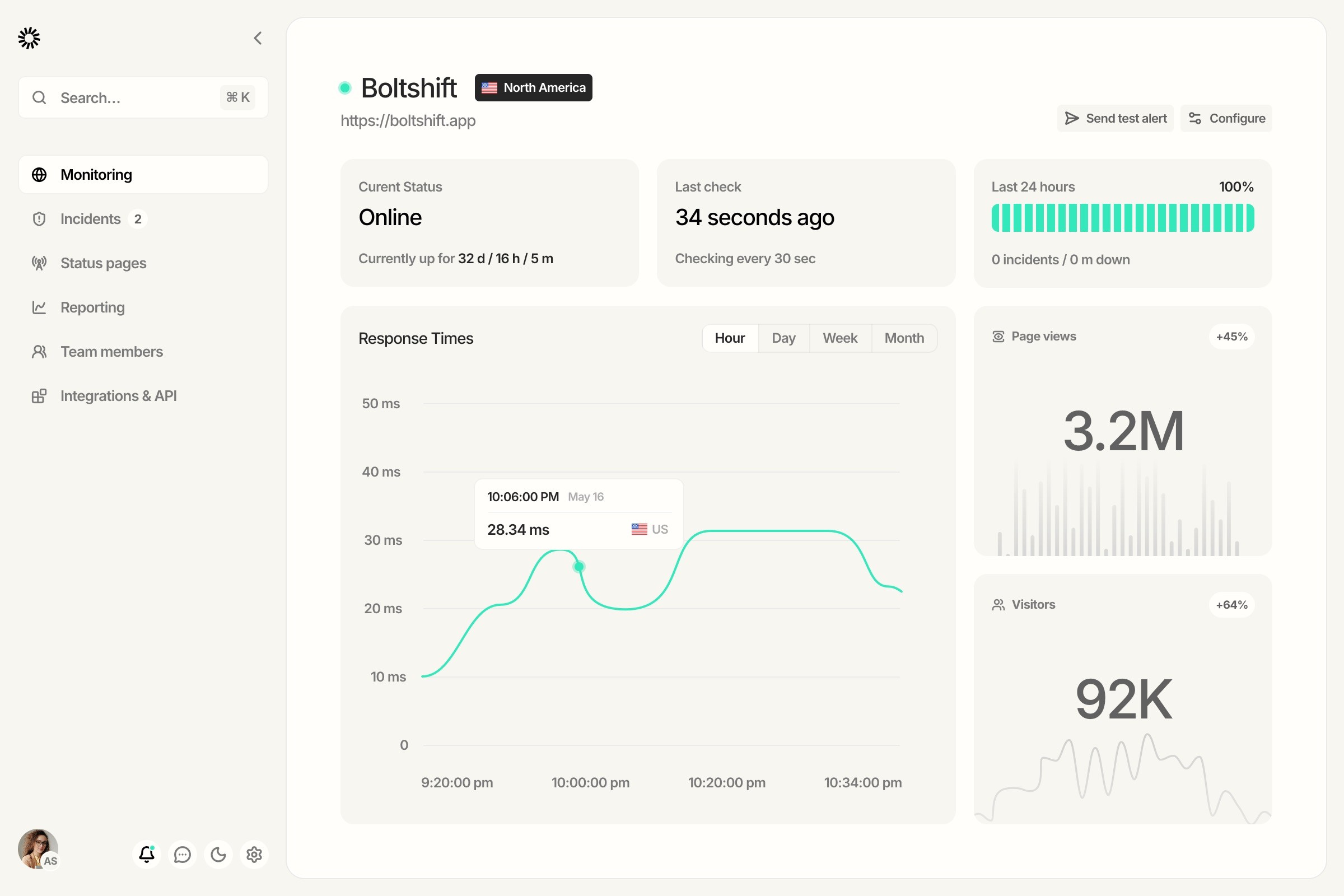
How Sola monitors your endpoints from 18 global regions simultaneously.
A deep dive into how Sola runs parallel checks from 18 regions around the world so you always know the true status of your services.

Sarah Mitchell
Co-founder & CTO
Why single-region monitoring lies to you
When your monitoring tool checks your endpoint from one location and reports it as up, that's only part of the story. Your users in Tokyo, Frankfurt, and São Paulo might be experiencing something very different. At Sola, we built our infrastructure around a simple belief: if a service is truly healthy, it should be healthy everywhere.
That's why every endpoint you add to Sola is monitored from 18 geographic regions, simultaneously, every minute.
The architecture behind 18-region checks
Each of our 18 monitoring nodes runs in a separate cloud region across North America, Europe, Asia-Pacific, South America, and the Middle East. Here's the full breakdown of our current monitoring network:
Region | Location | Provider |
|---|---|---|
US East | Virginia, United States | AWS |
US West | Oregon, United States | AWS |
US Central | Iowa, United States | GCP |
Canada | Montreal, Canada | AWS |
Europe West | Dublin, Ireland | AWS |
Europe Central | Frankfurt, Germany | AWS |
Europe North | Stockholm, Sweden | AWS |
UK | London, United Kingdom | GCP |
Asia Pacific | Tokyo, Japan | AWS |
Asia Pacific | Singapore | AWS |
Asia Pacific | Sydney, Australia | AWS |
Asia Pacific | Mumbai, India | AWS |
Asia Pacific | Seoul, South Korea | AWS |
Asia Pacific | Taipei, Taiwan | GCP |
South America | São Paulo, Brazil | AWS |
Middle East | Bahrain | AWS |
Africa | Cape Town, South Africa | AWS |
Southeast Asia | Jakarta, Indonesia | GCP |
Majority-rules alerting to eliminate false positives
Sola uses a majority-rules consensus model: we only alert you when a configurable threshold of regions reports a failure. A single flaky node in one region won't wake you up at 3am. You can tune this threshold per endpoint.
What this means for your on-call team
When Sola pages you, the alert includes a region breakdown — which specific regions are failing, their latency readings, and a timeline of when each region started detecting the issue. Your on-call engineer lands in the incident with context, not just a bare "service down" notification.